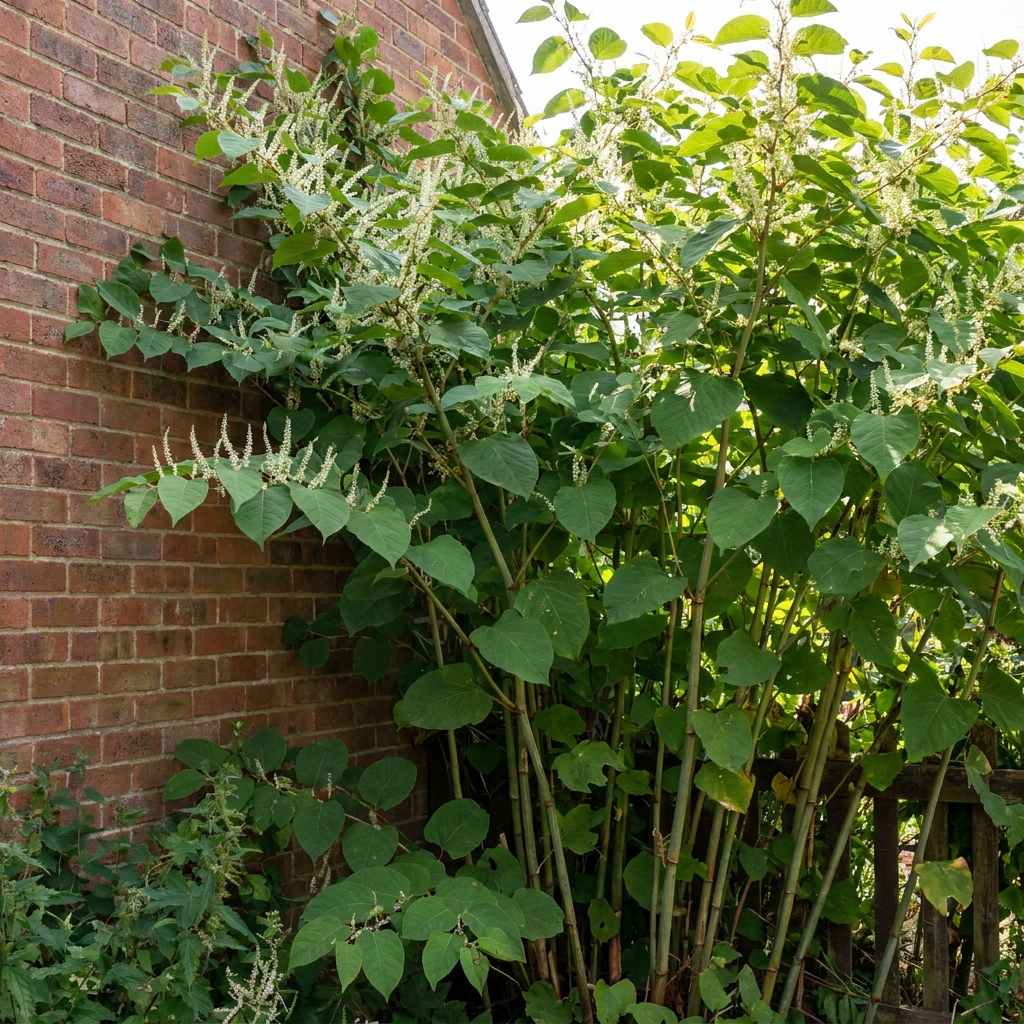
Japanese knotweed growing along a UK residential boundary
Independent UK Japanese knotweed guidance

Straight answers about Japanese knotweed.

No scaremongering, no hard sell — just clear, accurate guidance on identifying, treating and removing knotweed, and what it means for your property, mortgage and legal position. Sourced from the Environment Agency, RICS and the PCA.

Free · no obligationSourced from RICS & the Environment Agency
Environment Agency & RICS sourced Independent, not a contractor Free, no-obligation first survey enquiry

In 40 seconds

Japanese knotweed (Fallopia japonica) is an invasive plant that spreads underground through a tough rhizome system and is very hard to remove without specialist help. It is not illegal to have it on your land, but you must not allow it to spread — and you must disclose it when selling a home. The realistic options are a herbicide programme over about three seasons or full excavation, both best carried out by a PCA-accredited specialist. A house with knotweed is usually still mortgageable with a professional treatment plan backed by an insurance-backed guarantee. The single most important step is an accurate survey.

7m
old “rule” — relaxed by the 2022 RICS risk-based assessment
3
seasons — the typical length of a herbicide treatment programme
£1.5–3k
typical herbicide programme; excavation runs higher
0
obligation — the first survey enquiry is free
The answer library

Every question a worried homeowner actually asks.

Organised the way you think about the problem — what it is, how to treat it, what it means for your property, where you stand legally, and how to get it assessed.

Knotweed basics

What it is, how to be sure it’s knotweed, and how it behaves.

Pillar guide

What is Japanese knotweed?

The plant, where it came from, and why it matters so much in the UK.

Read the guide →
Basics

How to identify Japanese knotweed

The stems, leaves, flowers and seasonal changes that confirm it.

Read the guide →
Basics

Japanese knotweed flowers: when and what they look like

The late-summer creamy-white blooms that confirm the plant.

Read the guide →
Basics

What does Japanese knotweed look like in winter?

Dormant brown canes, hidden rhizome, and why it is easy to miss.

Read the guide →
Basics

Japanese knotweed vs bindweed

One climbs and twines; the other stands as a self-supporting cane.

Read the guide →
Basics

Japanese knotweed vs bamboo

Both have hollow canes — the leaves give the answer.

Read the guide →
Basics

Japanese knotweed vs lilac and other look-alikes

The most common spring false alarms — and how to be sure.

Read the guide →
Basics

Japanese knotweed roots and the rhizome system

The underground engine that makes the plant so persistent.

Read the guide →
Basics

How fast does Japanese knotweed spread?

Growth rate, how it travels, and why human disturbance is the main culprit.

Read the guide →
Basics

Is Japanese knotweed dangerous?

Not to people or pets — the real risk is to property and your legal position.

Read the guide →

Treatment & removal

How it’s actually killed and removed — methods, timescales and cost.

Treatment

How do you actually kill Japanese knotweed?

The realistic options – herbicide, excavation or a combination – and why a quick fix does not exist.

Read the guide →
Treatment

How much does Japanese knotweed removal cost?

A full breakdown of survey, herbicide, excavation and insurance-backed guarantee costs – and what drives the price.

Read the guide →
Treatment

Does glyphosate kill Japanese knotweed?

How glyphosate-based herbicide works, foliar spray vs stem injection, and why timing and repetition matter.

Read the guide →
Treatment

Can you dig out Japanese knotweed?

Full excavation vs on-site cell burial and root barriers – and why a single rhizome fragment ruins the job.

Read the guide →
Treatment

What is in a Japanese knotweed treatment plan?

The survey, chosen method, monitoring period and guarantee that make up a professional management plan – and why mortgage lenders ask for one.

Read the guide →
Treatment

How long does it take to kill Japanese knotweed?

Herbicide over several seasons plus monitoring, excavation in days – and why a stand can look dead but still be alive.

Read the guide →
Treatment

When do you need to excavate Japanese knotweed?

Dig-and-dump versus on-site burial and screening, what it costs, and the situations where excavation is the only realistic option.

Read the guide →
Treatment

Can I remove Japanese knotweed myself?

Legally you can treat it on your own land – but disposal law, spread liability and lender requirements make DIY a genuine risk.

Read the guide →
Treatment

How do you dispose of Japanese knotweed legally?

Why knotweed is controlled waste, where it must go, and why your bin, your compost and your local tip are not options.

Read the guide →
Treatment

Can you burn Japanese knotweed?

Drying and burning canes can reduce volume – but the rhizome still has to be killed, and the ash and any unburnt material remain controlled waste.

Read the guide →

Property & mortgages

Buying, selling and mortgaging a home with knotweed — the post-2022 reality.

Property

Can you get a mortgage on a house with Japanese knotweed?

In most cases yes – with a professional treatment plan and an insurance-backed guarantee.

Read the guide →
Property

Selling a house with Japanese knotweed

You can sell – but you must disclose, and a treatment plan keeps the buyer’s lender on side.

Read the guide →
Property

Buying a house with Japanese knotweed

It can be a sound purchase – if you survey it, price it and protect yourself properly.

Read the guide →
Property

How much does Japanese knotweed devalue a house?

The post-2022 picture: proportionate diminution, not automatic write-down.

Read the guide →
Property

What is a Japanese knotweed insurance-backed guarantee?

The document lenders rely on to protect their security for the life of the loan.

Read the guide →
Property

Japanese knotweed and the TA6 form

Question 7.8, the duty to answer honestly, and the risk of getting it wrong.

Read the guide →
Property

The Japanese knotweed 7-metre rule: what changed in 2022

From a rigid distance test to a risk-based assessment.

Read the guide →
Property

Does Japanese knotweed damage foundations?

The evidence-based answer, beyond the headlines.

Read the guide →
Property

Which lenders give mortgages on knotweed properties?

There is no fixed list – here is the spectrum and how to navigate it.

Read the guide →
Property

Knotweed management plan for a mortgage: what lenders require

The document that turns a flagged valuation into an approved mortgage.

Read the guide →

Law & disputes

Your rights, your neighbour’s duties, and when there’s a claim.

Law

Japanese knotweed law in the UK: the framework explained

Four pieces of law set out what you must – and must not – do about knotweed.

Read the guide →
Law

A neighbour’s knotweed is spreading onto my land – what can I do?

There is a clear escalation ladder, and litigation is the last rung.

Read the guide →
Law

Japanese knotweed encroachment claim: the law and what you can recover

After Williams v Network Rail, encroachment is actionable before any damage.

Read the guide →
Law

Is it illegal to have Japanese knotweed?

The short answer surprises people: having it is lawful; spreading it is not.

Read the guide →
Law

Japanese knotweed and the council: what can they be made to do?

Councils have a tool to compel others – and duties of their own.

Read the guide →
Law

The Network Rail knotweed case: Williams v Network Rail (2018) explained

The landmark that lets you sue a large landowner for encroaching rhizome.

Read the guide →
Law

Japanese knotweed claims: when to instruct a solicitor and the time limits

Litigation is the last rung – but get the timing right.

Read the guide →
Law

Seller hid the knotweed: a TA6 7.8 misrepresentation claim

If they ticked the wrong box, you may have a claim against the seller.

Read the guide →
Law

Japanese knotweed in a rented property: who is responsible?

Usually the landlord – but the tenancy and the spread risk both matter.

Read the guide →
Law

Spreading Japanese knotweed by fly-tipping: the offence explained

Move the soil carelessly and you can break two laws at once.

Read the guide →

Surveys & decisions

Getting it assessed properly and choosing the right plan.

Survey

What is a Japanese knotweed survey?

What a specialist inspection involves, and the report it produces for buyers, sellers and lenders.

Read the guide →
Survey

How to get a Japanese knotweed survey

What a survey includes, what it costs, and how to book a PCA-accredited surveyor.

Read the guide →
Survey

RICS knotweed management categories explained

How the 2022 RICS risk framework sorts knotweed into categories A to D — and what each means for a sale.

Read the guide →
Survey

How much does a Japanese knotweed survey cost?

The typical price, what moves it, and how a survey differs from the cost of a management plan.

Read the guide →
Survey

What is a PCA-accredited knotweed specialist?

Why the Property Care Association badge is the one lenders and buyers trust.

Read the guide →
Survey

Japanese knotweed: treatment vs removal

Herbicide programme or dig it out? How to choose on cost, time and circumstances.

Read the guide →
Survey

Japanese knotweed guarantees explained

Treatment guarantee vs insurance-backed guarantee — what each covers and how long it lasts.

Read the guide →
Survey

Are there grants to help with Japanese knotweed?

The honest answer on funding for private gardens — and the help that genuinely exists.

Read the guide →
Survey

What is a knotweed mortgage retention?

Why a lender holds back funds over knotweed, and how a guaranteed plan releases them.

Read the guide →
Survey

Japanese knotweed: frequently asked questions

Short, sourced answers to the questions people ask most about knotweed.

Read the guide →
How it works

From worried to a clear plan, in three steps.

You don’t need to know the right treatment before you enquire. That’s the surveyor’s job.

  1. Tell us what you’ve found. A short, no-obligation enquiry — where it is, how close to the house, and whether you’re buying, selling or staying.
  2. Get matched to a PCA-accredited surveyor. We connect you with an accredited specialist who surveys the site and confirms the extent and risk.
  3. Choose your plan with confidence. They set out your real options — treatment or removal — the cost, the guarantee, and what lenders will need.

Found something that might be knotweed?

Get it surveyed by a PCA-accredited specialist. It’s free to enquire, there’s no obligation, and an accurate survey is what protects your sale, your mortgage and your neighbour relations.

Enquiries are confidential. We never share your details without your say-so.