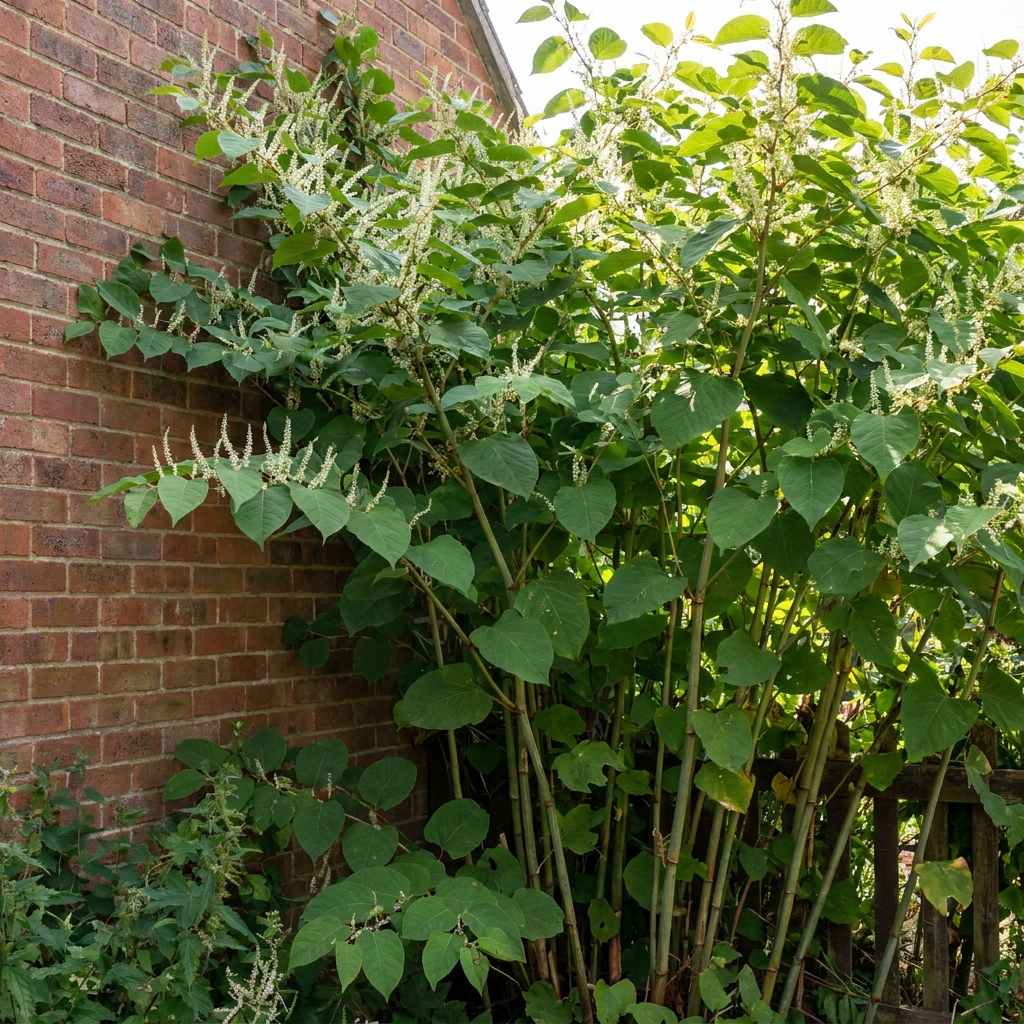
The short answer
A Japanese knotweed survey is a site inspection by a specialist who confirms whether knotweed is present, maps its extent, assesses the risk to the property and recommends a management approach. Since the 2022 RICS guidance, the surveyor places the infestation into a risk-based management category rather than applying the old fixed 7-metre rule. You receive a written report — often the document a mortgage lender or solicitor will ask to see.
If knotweed is suspected on or near a property, a guess is worth nothing — lenders, solicitors and buyers want a specialist’s written assessment. A Japanese knotweed survey is that assessment. It identifies the plant, records how far it has spread, judges the risk to the building and the boundary, and sets out what should be done. This page explains what the survey involves, who carries it out, and what the report contains.
Knotweed surveys at a glance
- Who does it A PCA-accredited invasive weed specialist or qualified surveyor
- Typical cost £150–£350 for a survey and report
- Output A written report with a RICS-style risk category and recommendation
- Standard 2022 RICS knotweed guidance — risk-based, not the old 7m rule
- Why Often required by lenders and solicitors during a sale or purchase
What a survey actually involves
A survey is a physical inspection of the property and its boundaries. The specialist walks the garden and adjacent land where access allows, identifies the plant (ruling out look-alikes such as bindweed or bamboo), and records the location and extent of any stand. They note proximity to the dwelling, outbuildings, drains, paving and the boundary with neighbouring land, and look for signs of previous treatment.
- Confirmation that the plant is Fallopia japonica — not a similar-looking species.
- Measurement and mapping of the affected area and any growth crossing a boundary.
- An assessment of risk to the property and to neighbouring land.
- A recommended management approach and, where needed, a costed plan.
The RICS risk-based assessment
The 2022 RICS guidance note replaced the rigid “7-metre rule” with a risk-based framework. Rather than treating any knotweed within seven metres as automatically problematic, the surveyor judges the actual risk the infestation poses to that specific property — its proximity to the building, the boundary and the likely impact on value — and assigns a management category. This gives lenders a more proportionate picture and means many cases that once failed a mortgage now proceed with a plan in place. See the RICS categories explained.
| Survey element | What it covers |
|---|---|
| Identification | Confirms the species and rules out look-alikes |
| Extent | Maps the stand and any cross-boundary growth |
| Risk category | Places the case in a RICS management category |
| Recommendation | Treatment programme, excavation or monitoring |
The report you receive
The output is a written report. For a lender or solicitor it needs to be clear about the risk category and the recommended action. Where treatment is advised, the report — or a follow-up management plan — will typically set out the method, the number of seasons and whether an insurance-backed guarantee is available. A management plan with an insurance-backed guarantee is frequently what unlocks a mortgage.
When you need one
Order a survey if knotweed is suspected when buying or selling, if a lender or solicitor asks for one, or if you have a possible boundary dispute with a neighbour. A clear report removes uncertainty for everyone in the chain.
Frequently asked questions
How long does a knotweed survey take?
A typical residential inspection takes about 30–60 minutes to carry out; the written report usually follows within a few working days.
Do I need a survey to get a mortgage?
If knotweed is present or suspected, lenders generally want a specialist report and, often, a management plan with an insurance-backed guarantee before they lend.
Can a normal homebuyer’s survey identify knotweed?
A general surveyor may flag a suspected stand, but identification and a risk category usually need a specialist knotweed survey to satisfy a lender.
Does a survey remove the knotweed?
No. A survey assesses and recommends; removal or treatment is a separate, costed programme carried out by a specialist.
Sources & further reading
- RICS — Japanese Knotweed and Residential Property guidance note (2022)
- Property Care Association (PCA) — Invasive Weed Control Group standards
- GOV.UK — Prevent Japanese knotweed from spreading
This guide is general information, not a site-specific survey or legal advice. Japanese knotweed treatment and removal should be assessed by a PCA-accredited specialist before you act.