The short answer
Japanese knotweed (Fallopia japonica) is a non-native, invasive perennial plant introduced to the UK in the 19th century as an ornamental. It spreads underground through a tough root system called a rhizome, growing up to around 10cm a day in summer and reaching 2–3 metres tall. It is not poisonous, but it can damage hard surfaces, out-compete native plants and complicate property sales and mortgages. Under the Wildlife & Countryside Act 1981 it is an offence to cause it to spread in the wild.
Few garden plants carry the reputation of Japanese knotweed. It looks unremarkable — tall green canes and broad leaves — yet it is one of the most heavily regulated plants in Britain and a recurring sticking point in house sales. This guide explains exactly what the plant is, where it came from, how it grows, and why surveyors, lenders and the Environment Agency treat it so seriously.
Japanese knotweed at a glance
- Scientific name Fallopia japonica (syn. Reynoutria japonica)
- Type Non-native invasive herbaceous perennial
- Introduced to UK Mid-19th century, as an ornamental
- Peak growth Up to ~10cm per day in late spring/summer
- Mature height 2–3 metres in a single season
- Legal status Spreading it in the wild is an offence (W&CA 1981)
The plant itself
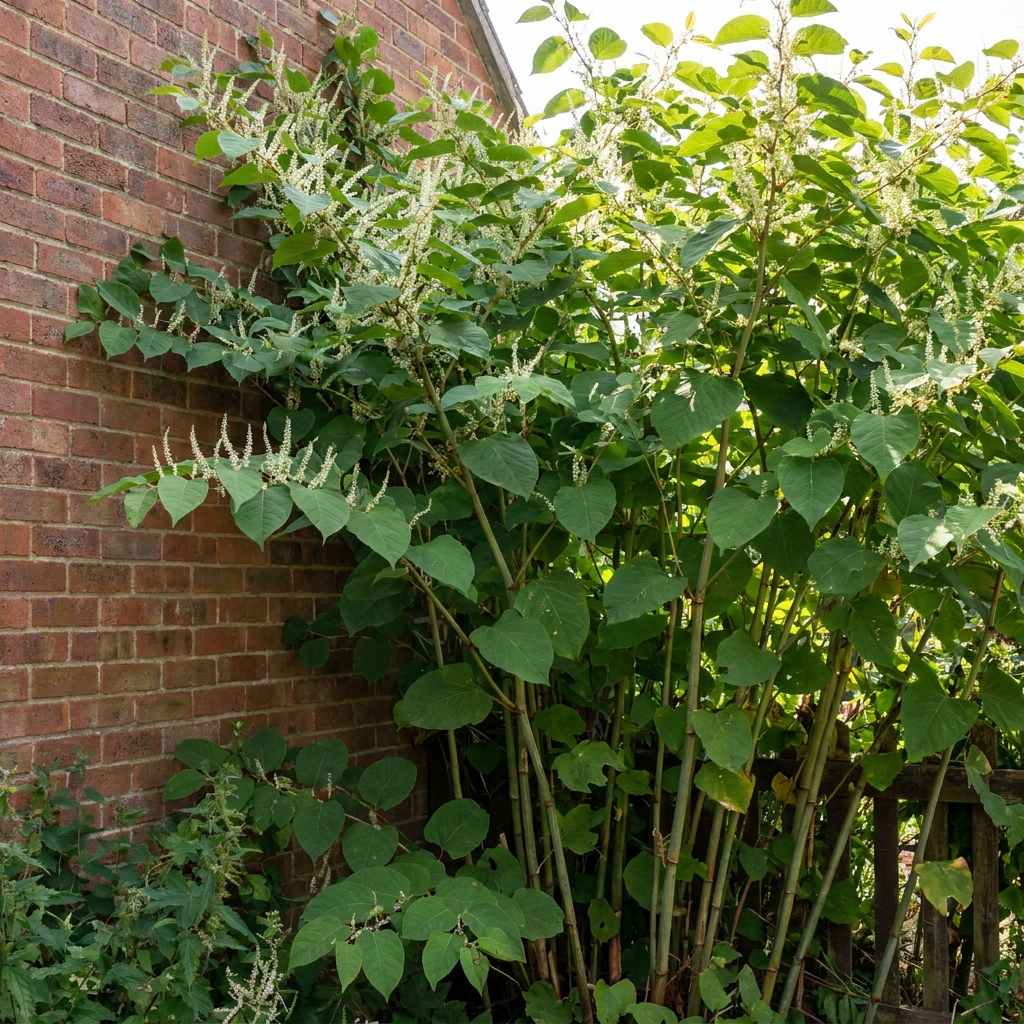
Japanese knotweed is a herbaceous perennial: the visible green growth dies back each autumn, but the plant survives the winter underground and re-emerges the following spring. Its botanical name is Fallopia japonica (you will also see it written as Reynoutria japonica). In summer it produces hollow, bamboo-like canes flecked with red or purple, broad shovel-shaped leaves arranged in a zig-zag along the stem, and sprays of creamy-white flowers in late summer.
It is a vigorous coloniser. A single clump can form a dense thicket that shades out native vegetation, and its strength comes from below ground — a network of roots known as the rhizome. If you want to confirm a plant, see our detailed guide on how to identify Japanese knotweed.
Where it came from
Japanese knotweed is native to East Asia, where volcanic soils, grazing animals and natural pests keep it in check. It was brought to Europe in the 19th century as an ornamental and fodder plant, and was being sold in British nurseries by the mid-1800s. With none of its natural controls present here, it spread rapidly. Crucially, every plant in the UK is thought to descend from a single female clone, which is why it sets no viable seed in this country and spreads almost entirely by vegetative means.
Why it matters in the UK
The concern is rarely the plant’s appearance — it is what the rhizome can do and what the law requires. Knotweed can exploit existing weaknesses in hard surfaces, drains and structures, and dense growth can affect access and amenity. More commonly, its presence affects the practical and financial side of owning property: it can complicate mortgage applications, house sales and relations with neighbours.
| Concern | What it means |
|---|---|
| Property & structures | Can exploit cracks in tarmac, paving, drains and walls; rarely causes structural collapse |
| Mortgage & sale | Lenders often require a survey and a treatment plan with insurance-backed guarantee |
| Legal | Causing it to spread in the wild is an offence; it can also lead to private nuisance claims between neighbours |
| Ecology | Out-competes native plants and reduces biodiversity along riverbanks and waste ground |
This is why the plant sits at the centre of property law and lending policy. The leading court authority, Williams v Network Rail (2018), confirmed that knotweed encroaching from neighbouring land can amount to an actionable private nuisance. For more detail see Japanese knotweed law in the UK and how it affects a mortgage.
The lifecycle in brief
- Spring — red or purple asparagus-like shoots push up, then unfurl rapidly into leafy canes.
- Summer — full growth, up to 2–3 metres, with dense green foliage; this is the period of fastest spread.
- Late summer/autumn — creamy-white flower clusters appear before the canes die back.
- Winter — canes turn brown and brittle and stand dormant; the rhizome remains alive underground.
Frequently asked questions
Is Japanese knotweed poisonous?
No. Japanese knotweed is not poisonous to people or pets, and the young shoots are even edible. The risk it poses is to property, native ecology and the legal/financial side of selling or mortgaging a home — not toxicity.
Is it illegal to have Japanese knotweed in my garden?
No. It is not an offence to have it growing on your own land. It is an offence under the Wildlife & Countryside Act 1981 to plant it or cause it to grow in the wild, and you have a legal duty not to let it spread onto neighbouring property.
How quickly does Japanese knotweed grow?
In late spring and summer it can grow up to around 10cm a day, reaching 2–3 metres in a single season. Most of the plant’s mass, however, is the underground rhizome.
Does Japanese knotweed produce seeds in the UK?
Effectively no. UK plants are a single female clone, so they do not set viable seed here. Spread is almost entirely vegetative — through rhizome growth and movement of cut stems or contaminated soil.
Sources & further reading
- Environment Agency — Treatment and disposal of invasive non-native plants
- gov.uk — Prevent the spread of harmful invasive and non-native plants
- RICS — Japanese knotweed and residential property guidance note (2022)
- Wildlife & Countryside Act 1981 — Section 14 and Schedule 9
- Williams v Network Rail Infrastructure Ltd (2018) EWCA Civ 1514
This guide is general information, not a site-specific survey or legal advice. Japanese knotweed treatment and removal should be assessed by a PCA-accredited specialist before you act.