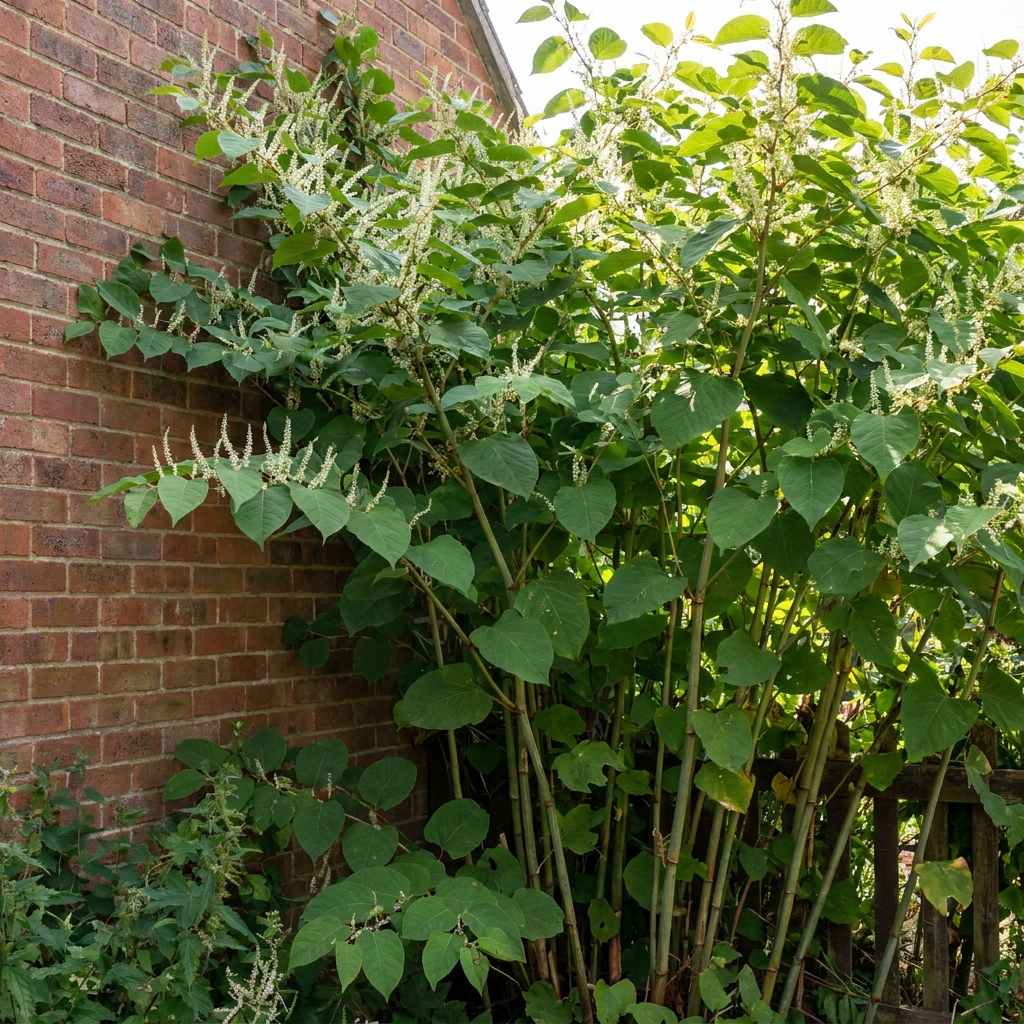
The short answer
Japanese knotweed’s real strength is its rhizome — an underground stem system that can extend several metres laterally and a few metres deep, and from which a fragment as small as a fingernail can grow a whole new plant. The visible canes are only part of the story; most of the plant’s mass and energy is below ground. This is why cutting or digging without care spreads it, and why effective control targets the rhizome over several seasons.
To understand why Japanese knotweed is so hard to remove, you have to look underground. The rhizome — not the leafy canes — is what makes the plant persistent, what allows it to regrow after cutting, and what surveyors and lenders are really concerned about. This page explains how the rhizome system works, how far it can reach, and why a single fragment is enough to start again.
The rhizome at a glance
- What it is Underground stem system (not a true root)
- Lateral spread Commonly cited up to ~7 metres from the parent plant
- Depth Can reach a few metres (often quoted up to ~2–3m)
- Regrowth A small fragment can grow a new plant
- Appearance Knotty, woody, dark outside, orange inside when snapped
- Control Targeted over several seasons by a specialist
What the rhizome is
A rhizome is an underground stem, not a true root, and it is the heart of the knotweed plant. It stores energy, sends up the spring shoots and spreads the plant sideways through the soil. Knotweed rhizome is knotty and woody, dark brown on the outside, and snaps to reveal an orange or yellowish centre — a useful identification feature for specialists. The visible canes are seasonal; the rhizome is the permanent, living part that survives winter and regrows year after year.
How far it reaches
The rhizome can extend a considerable distance from the visible plant. A lateral spread of up to around seven metres is widely cited and underpins the historic surveying convention — the so-called “7-metre rule”. It can also penetrate downward, with depths of a few metres reported. These figures are general guidance rather than fixed limits: actual extent depends on soil, age of the stand and conditions, which is one reason the rigid 7-metre convention was relaxed in the 2022 RICS guidance in favour of a risk-based assessment. See the RICS categories and the 7-metre rule.
| Aspect | Typical position |
|---|---|
| Lateral spread | Commonly cited up to ~7m from the parent stand |
| Depth | Often quoted up to ~2–3m, deeper in some conditions |
| Minimum regrowth fragment | A fragment of only a few grams can regenerate |
| Energy store | Rhizome holds reserves that fuel spring regrowth |
Why a fragment regrows
Because the rhizome stores so much energy and can regenerate from a small piece, any disturbance that breaks it up risks creating new plants. This is the central reason that cutting, strimming, rotavating or excavating without specialist control can dramatically worsen an infestation. It is also why contaminated soil is treated as controlled waste under the Environmental Protection Act 1990 and must be handled correctly. Spread by fragments is covered further in how fast knotweed spreads.
Why it is so hard to kill
Effective control has to reach the rhizome, not just the canes. Herbicide programmes use the plant’s own transport system — applying glyphosate when the plant is moving sap down to the rhizome in late summer — and typically run over three or more growing seasons. Excavation (“dig and dump”) physically removes the rhizome but is expensive and generates controlled waste. Either way, the rhizome is the target. See how to kill it and glyphosate treatment.
Frequently asked questions
How deep do Japanese knotweed roots go?
The rhizome can reach a few metres deep — figures of up to around 2–3 metres are commonly quoted, with deeper penetration possible in some conditions. Actual depth depends on soil and the age of the stand.
How far does the knotweed rhizome spread sideways?
Lateral spread of up to around seven metres from the visible plant is widely cited, which underpinned the historic 7-metre surveying convention. The 2022 RICS guidance moved to a risk-based assessment rather than a rigid distance.
Can Japanese knotweed grow back from a small piece of root?
Yes. A small fragment of rhizome — only a few grams — can regenerate into a new plant. This is why disturbing or digging the plant without specialist control spreads it.
Why is the rhizome so hard to kill?
Most of the plant’s mass and energy is in the rhizome, not the visible canes. Effective control must reach it — usually a multi-season herbicide programme or full excavation by a specialist.
Sources & further reading
- Environment Agency — Treatment and disposal of invasive non-native plants
- RICS — Japanese knotweed and residential property guidance note (2022)
- Property Care Association (PCA) — Management of Japanese knotweed
- Environmental Protection Act 1990 — controlled waste provisions
This guide is general information, not a site-specific survey or legal advice. Japanese knotweed treatment and removal should be assessed by a PCA-accredited specialist before you act.