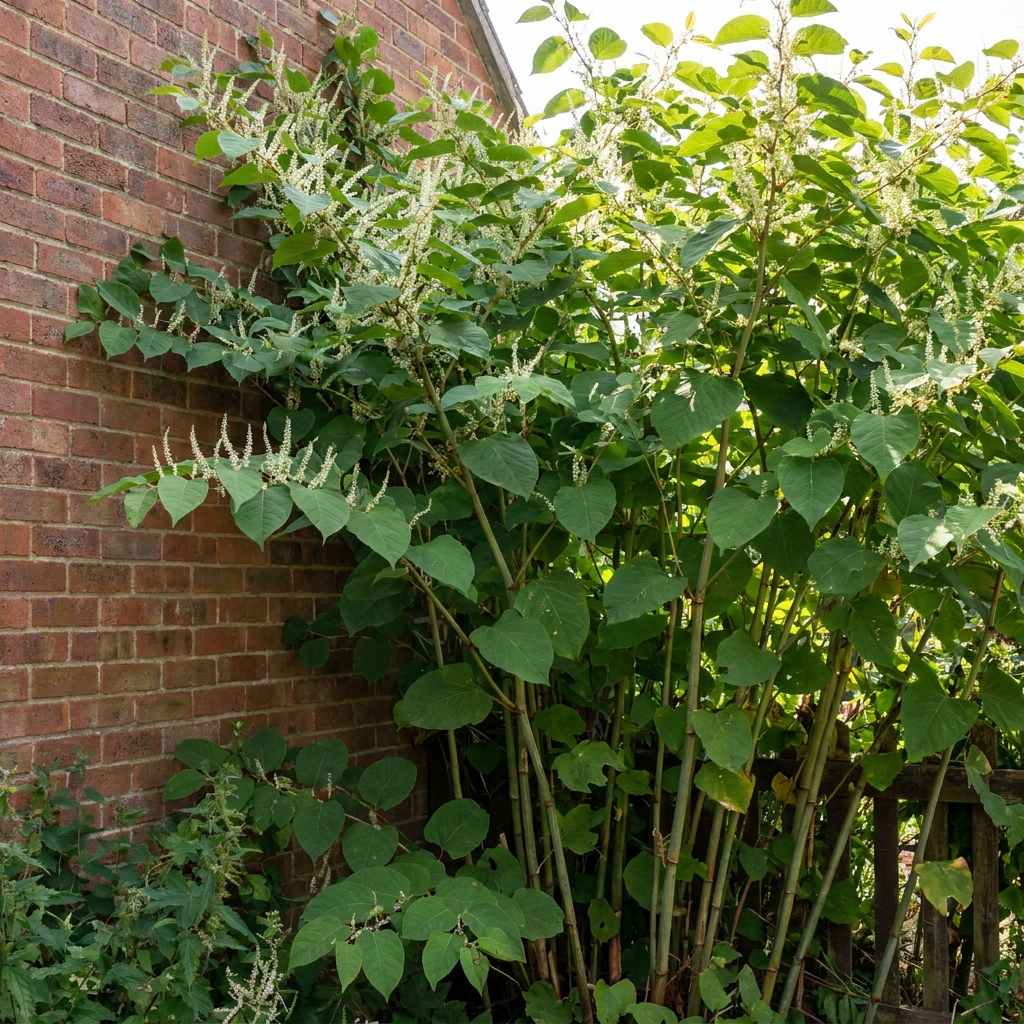
The short answer
Japanese knotweed rarely damages sound, modern foundations. It does not have the force to break solid concrete; instead it exploits pre-existing weaknesses – cracks, gaps, drains, old walls and tarmac. The risk is real but often overstated. The 2022 RICS guidance reflects this more measured view, and the leading court case, Williams v Network Rail (2018), treated knotweed primarily as a blight on use and value rather than as a foundation-wrecker.
Few garden plants have a scarier reputation than Japanese knotweed, and the claim that it ‘destroys foundations’ is repeated everywhere. The evidence is more nuanced. Knotweed is opportunistic rather than destructive: it pushes through existing gaps and weak points, but it does not bore through intact structural concrete. Understanding the real mechanism helps you judge the true risk – and avoid both complacency and panic.
Knotweed and foundations at a glance
- Breaks sound concrete? No
- Exploits existing cracks? Yes
- Main targets Drains, tarmac, old walls, joints
- Modern foundations Rarely affected if intact
- Court context Williams v Network Rail (2018)
- Practical priority Treat early; protect drains
What knotweed can and cannot do
Japanese knotweed is a vigorous plant with persistent underground rhizome, but it lacks the mechanical force to penetrate sound, intact concrete or solid modern foundations. What it does well is find and exploit existing weaknesses. Where there is already a crack, an open joint, a failing damp-proof course, a gap around a drain or a worn patch of tarmac, knotweed shoots can grow through and widen it. So the damage you sometimes see is usually the plant taking advantage of a pre-existing defect, not creating structural failure from scratch.
| Feature | Typical vulnerability |
|---|---|
| Sound modern foundations | Low – rarely affected if intact |
| Drains & underground pipes | Higher – exploits joints and gaps |
| Tarmac / paving | Higher – pushes through worn surfaces |
| Old/cracked masonry walls | Higher – widens existing cracks |
| Conservatories, light structures | Moderate – can lift weak slabs |
What the evidence and courts say
The 2022 RICS guidance moved away from treating every infestation as a structural emergency, recognising that the principal harm is often to amenity, saleability and value rather than to the building itself. The leading authority, Williams v Network Rail Infrastructure Ltd (Court of Appeal, 2018), is instructive: the court allowed the neighbours’ claim in private nuisance on the basis that knotweed encroachment interfered with their enjoyment and use of their land and burdened it, rather than on proof that it had wrecked their foundations. The case confirms knotweed is a serious legal nuisance – but the harm recognised was blight, not structural collapse.
Why the reputation persists
Much of the ‘destroys foundations’ fear comes from rail and infrastructure contexts – Network Rail has spent heavily controlling knotweed along the railway – and from older, more alarmist property advice. On a typical home with sound foundations, the realistic risks are to drains, paving and outbuildings, plus the value and mortgage impact addressed in our guide to house value.
What to do
- Treat early with a PCA-accredited specialist – see how to kill knotweed.
- Keep it away from drains, walls and hard surfaces.
- Get a survey if it is close to the building, so the risk is properly assessed.
This is general information, not a structural survey. If you are concerned about damage to a specific building, instruct a chartered surveyor and a PCA-accredited specialist.
Frequently asked questions
Can Japanese knotweed grow through concrete foundations?
Not through sound, intact concrete – it lacks the force. It can grow through existing cracks, joints and gaps, so the damage usually reflects a pre-existing defect that the plant has exploited and widened rather than structural penetration of solid concrete.
Will knotweed wreck the foundations of my house?
Rarely, if the foundations are sound and modern. The more realistic risks are to drains, tarmac, paving, conservatories and old or cracked walls. It should still be treated, because it spreads and affects value even where structural risk is low.
Why does knotweed have such a fearsome reputation then?
Much of it stems from infrastructure settings like railways, where Network Rail has spent heavily on control, and from older alarmist advice. The 2022 RICS guidance and the courts treat the main harm as blight on use and value rather than foundation destruction.
Did Williams v Network Rail say knotweed damages buildings?
No. The 2018 Court of Appeal decision allowed a private nuisance claim because the encroaching knotweed interfered with the claimants’ use and enjoyment of their land, not because it had damaged foundations. It confirms knotweed is a legal nuisance based on blight.
Sources & further reading
- Williams v Network Rail Infrastructure Ltd [2018] EWCA Civ 1514 (Court of Appeal)
- RICS — Japanese knotweed and residential property, guidance note (2022)
- Property Care Association (PCA) — Invasive Weed Control Group
- gov.uk — Prevent Japanese knotweed from spreading
This guide is general information, not a site-specific survey or legal advice. Japanese knotweed treatment and removal should be assessed by a PCA-accredited specialist before you act.