The short answer
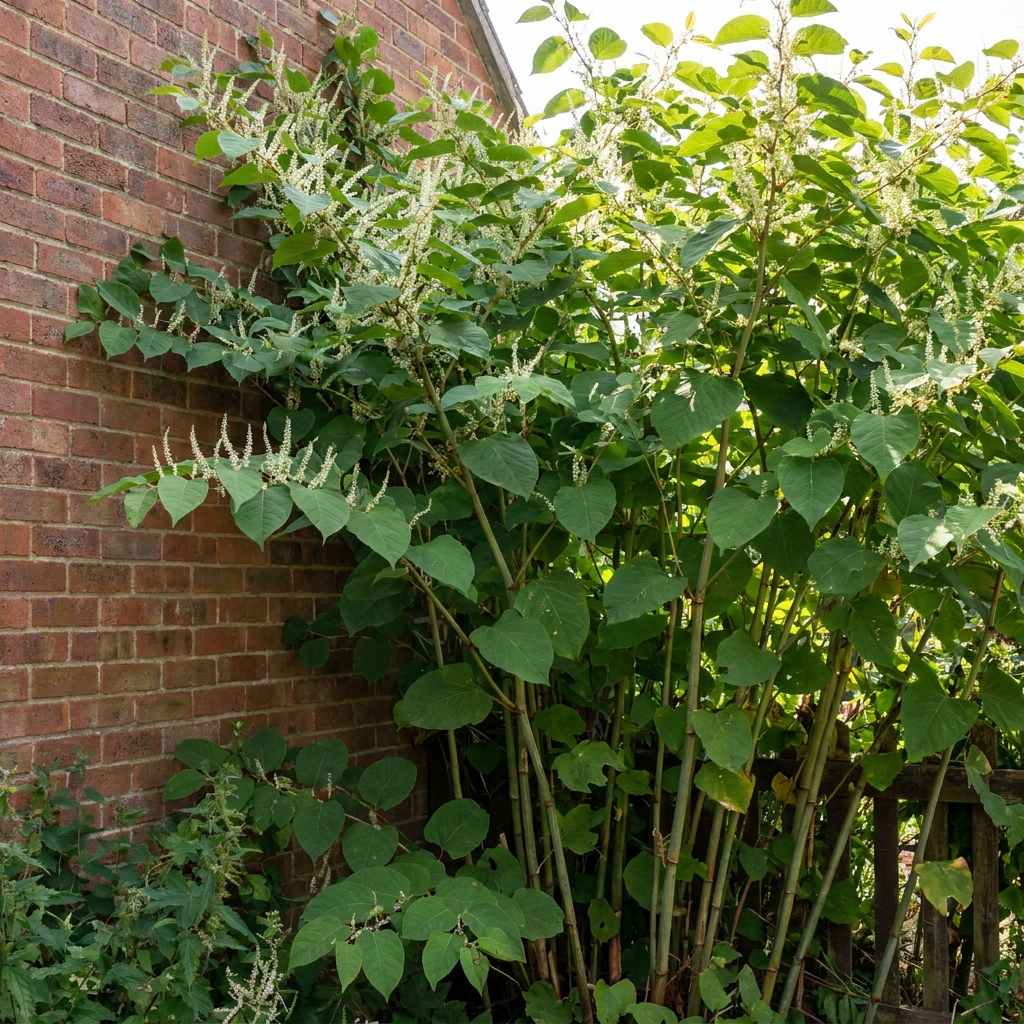
The simplest difference is habit: bindweed is a climbing, twining weed that wraps around other plants and fences, while Japanese knotweed stands upright as a self-supporting, hollow, bamboo-like cane. Bindweed has arrow-shaped leaves and large white or pink trumpet flowers; knotweed has broad heart-shaped leaves in a zig-zag and small creamy-white flower sprays. If the plant is twining around something, it is not knotweed.
Bindweed is one of the plants most often mistaken for Japanese knotweed, partly because both are vigorous and unwelcome. In reality they look quite different once you know what to check. This page sets out the clear distinguishing features — growth habit, leaves, flowers and stems — so you can tell them apart with confidence.
Knotweed vs bindweed at a glance
- Knotweed habit Upright, self-supporting cane, 2–3m
- Bindweed habit Twining climber that wraps around supports
- Knotweed leaves Broad heart/shovel-shaped, zig-zag pattern
- Bindweed leaves Arrow- or shield-shaped, on twining stems
- Knotweed flowers Small creamy-white sprays, late summer
- Bindweed flowers Large white or pink trumpet flowers
The clearest test: growth habit
The fastest way to separate the two is to watch how the plant grows. Bindweed (both hedge and field bindweed) is a climber: its thin stems twine around fences, other plants and any support they can find, and it cannot stand up on its own. Japanese knotweed does the opposite — it produces stout, hollow canes that stand 2–3 metres tall without support. If a plant is wrapping itself around something, it is bindweed, not knotweed.
Leaves
Bindweed leaves are arrow- or shield-shaped with a pointed tip and lobes at the base, carried on slender twining stems. Japanese knotweed leaves are much larger and broader — shovel- or heart-shaped with a flat base — and arranged in a regular alternating zig-zag along a thick cane. The sheer size and the zig-zag arrangement are good knotweed markers covered in our identification guide.
Flowers
Bindweed is unmistakable in flower: it produces large, showy white or pink trumpet-shaped blooms a few centimetres across. Japanese knotweed flowers are the opposite — tiny, creamy-white and carried in loose branching sprays in late summer, as described on our flowers page.
| Feature | Japanese knotweed | Bindweed |
|---|---|---|
| Habit | Upright self-supporting cane | Twining climber |
| Stems | Hollow, bamboo-like, red/purple speckled | Thin, flexible, twining |
| Leaves | Large heart/shovel-shaped, zig-zag | Arrow/shield-shaped |
| Flowers | Small creamy-white sprays | Large white/pink trumpets |
| Property/legal concern | Significant — mortgages, sales, nuisance | A garden nuisance only |
Why the difference matters
Bindweed is an annoyance in a border, but it carries none of the property, mortgage or legal consequences that knotweed does. Confusing the two can cause needless worry — or, the other way around, a false sense of security. If there is any doubt near a boundary, drains or a building, confirm it properly. See what Japanese knotweed is and our guide to a survey.
Frequently asked questions
How do I tell bindweed from Japanese knotweed?
Check the growth habit first. Bindweed twines and climbs around supports and cannot stand alone; Japanese knotweed stands upright as a hollow, bamboo-like cane up to 2–3 metres. Bindweed has arrow-shaped leaves and trumpet flowers; knotweed has heart-shaped leaves in a zig-zag and creamy-white flower sprays.
Is bindweed as serious as Japanese knotweed?
No. Bindweed is a persistent garden weed but carries none of the property, mortgage or legal consequences associated with Japanese knotweed.
Do bindweed and knotweed flower at the same time?
They can overlap in late summer, but the flowers are very different: bindweed has large white or pink trumpets, while knotweed has tiny creamy-white flowers in branching sprays.
Can bindweed damage property like knotweed?
No. Bindweed does not have the invasive rhizome system or the legal status of Japanese knotweed, so it is not a concern for mortgages, sales or nuisance claims.
Sources & further reading
- Property Care Association (PCA) — Identification of Japanese knotweed
- Environment Agency — Identify and control invasive non-native plants
- gov.uk — Prevent the spread of harmful invasive and non-native plants
This guide is general information, not a site-specific survey or legal advice. Japanese knotweed treatment and removal should be assessed by a PCA-accredited specialist before you act.